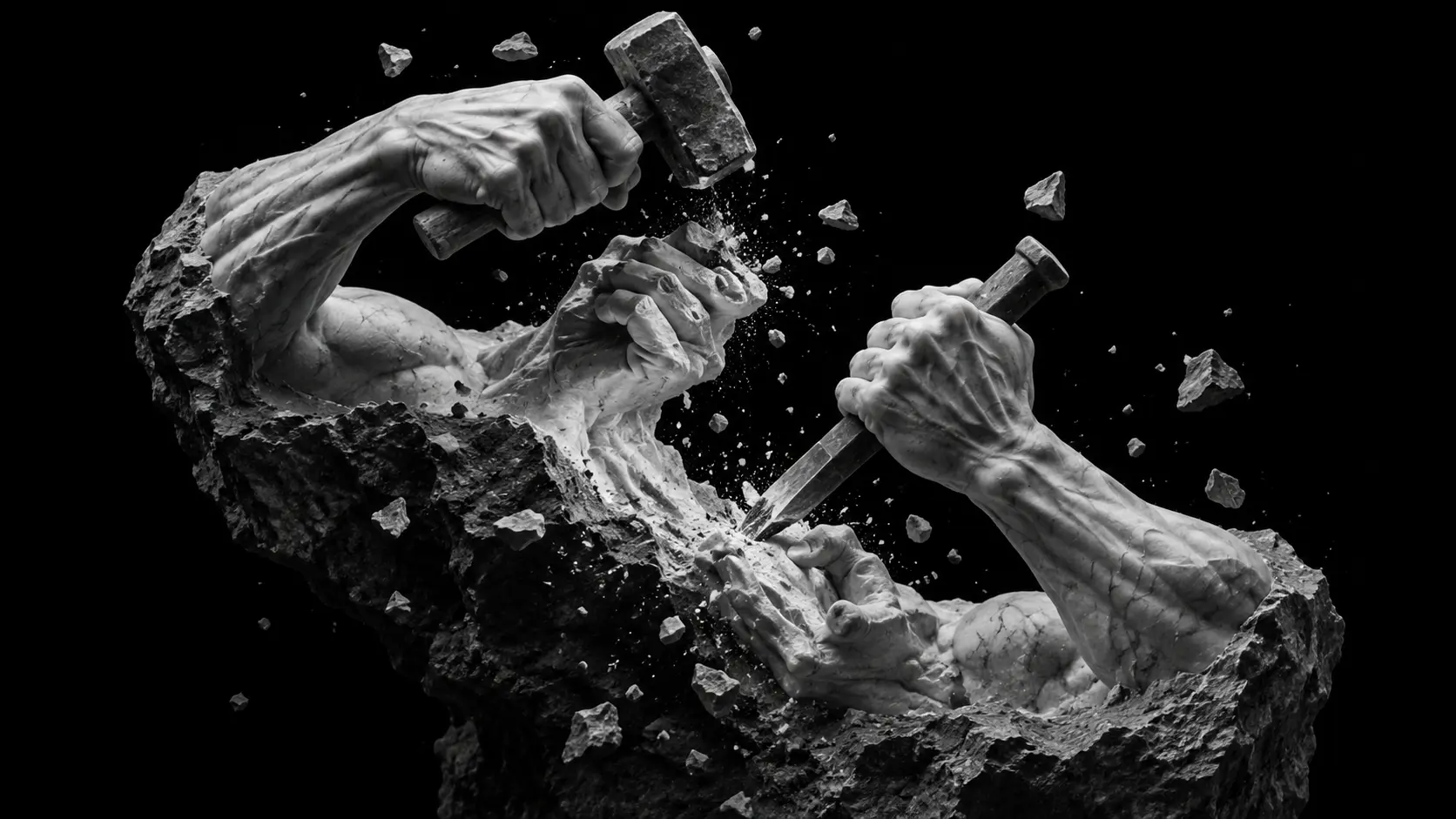
The Illusion of Two Castes
It is commonly believed that civilization rests on a strict symbiosis between two unequal castes.
On one side stand solitary demiurges, visionaries, and world architects capable of seeing beyond the horizon. On the other lies a nameless army of narrow specialists, living calculators, and cogs whose purpose is to lay bricks inside someone else’s master plan. For centuries, we have been taught that this hierarchy is sacred: that progress is impossible without a rigid vertical dividing humanity into those who think and those who merely keep the gears turning.
Yet this hierarchy is a fundamental illusion. An industrial myth engineered for the convenience of managing the masses.
Look at the physical universe. It knows no job descriptions. It has no tables of rank, no diplomas, no bureaucratic regulations, and no preordained rulers. Matter is utterly neutral. Stars, gravitational fields, silicon, carbon, and the quantum vacuum form a pristine, indifferent foundation.
Before an indifferent Universe, every human mind carries identical ontological weight.
The laws of physics do not require a creator to ask for permission. Gravity does not care who calculates the orbital trajectory—a celebrated academician or a nameless enthusiast in a garage. Code compiles not because its author holds high status, but because the logic is free of contradictions.
Caste systems exist solely within human interfaces—in bureaucratic scaffolds designed to conserve cognitive energy. But at the raw point of contact with reality, no hierarchy exists. There is only consciousness and the resistance of the material.
The ability to create worlds was never the genetic privilege of the chosen few. It has always been the natural state of any human being who found the audacity to step directly into the unknown.
The Universe knows no masters. It answers anyone who speaks to it in the language of direct action.
The Recursion of Tools
Civilization has never moved forward by royal decrees or committee mandates. It advanced through a grand, unbroken relay of tools.
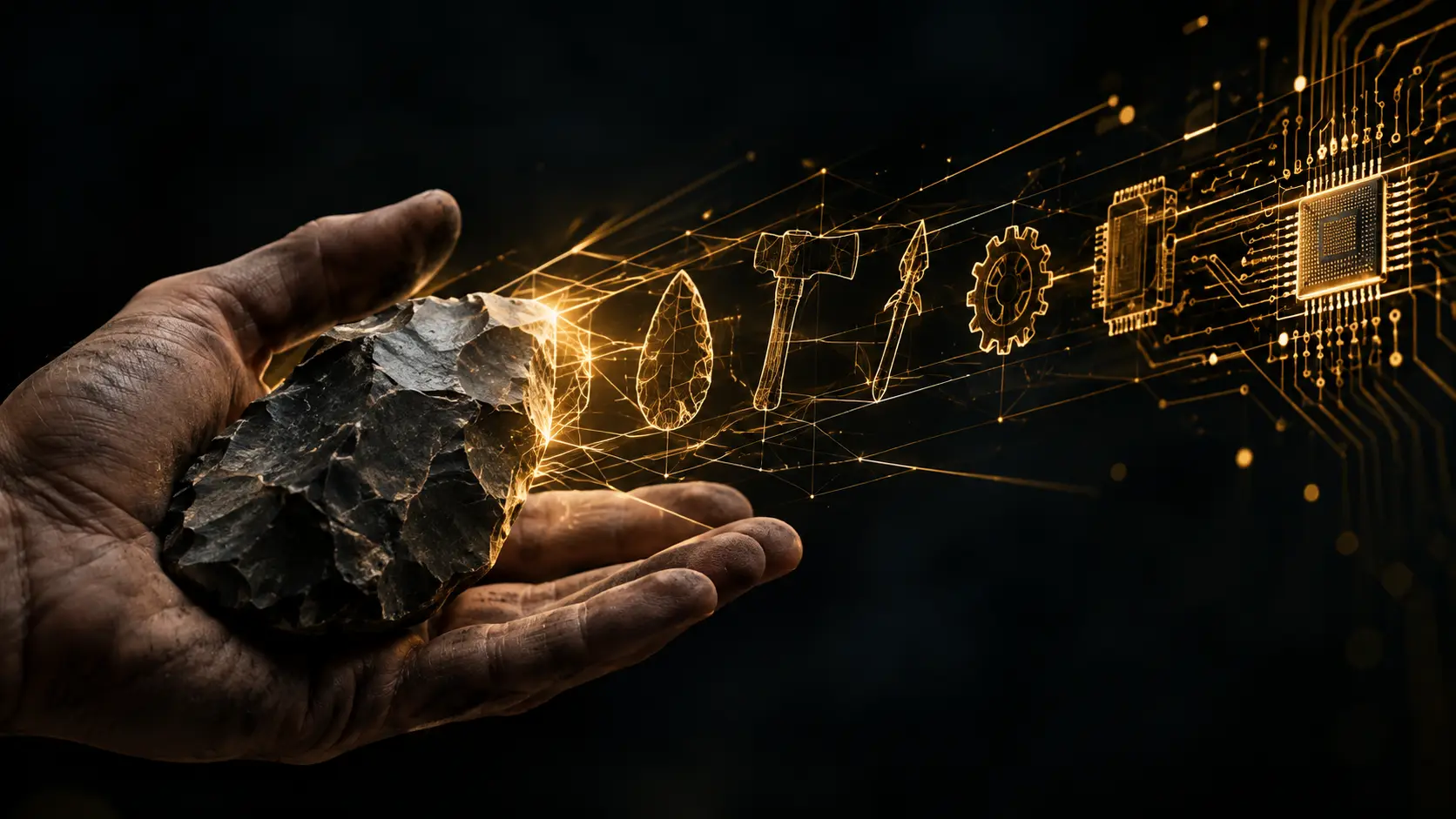
When our distant ancestor first picked up a river pebble and chipped its edge with another stone, he was not executing someone else’s directive. He entered into direct dialogue with nature and forged the first hand axe—a tool of the first order.
Yet the true revolution occurred in the following moment. He did not take that shape to his grave, nor did he declare it the proprietary monopoly of his ego. He left it by the fire. Another human took that stone, carved a wooden shaft, bound it with plant fibers, and created a spear—a tool of the second order.
Thus began the recursion of creation:
Stone gave birth to the chisel.
The chisel gave birth to the lever and the wheel.
The lathe gave birth to the silicon wafer.
Assembly language gave birth to compilers, upon which neural networks arose.
No generation begins civilization from scratch. We inherit our ancestors’ legacy as an open foundation and erect the next layer of abstraction upon it.
Human culture is a colossal open-source codebase, where every tool serves as a springboard for an even more powerful instrument.
In this chain of creation, there are neither masters nor subordinates. Everyone who contributes to the architecture of reality takes part in a shared act of genesis.
When Grigori Perelman proved Poincaré’s conjecture—the fundamental topology of our three-dimensional universe—he published his complete findings in the open arXiv repository. He walked away from the Fields Medal and a million-dollar prize, slamming the door on the institutional vanity fair. Spectators saw this as madness or weakness. But for a creator, it was an act of absolute sovereignty.
He did not solve the formula for career, applause, or corporate metrics. He unlocked a fundamental truth of the cosmos and bestowed it upon humanity as a higher-order tool. He needed no judges: truth is self-evident.
At its highest peak, creation is selfless. It is an act of continuing the open-source code of humanity.
A true creator does not conquer territory. They expand the volume of space accessible to the world.
The Weight of Freedom
If the foundation is neutral and the tools are open to all—why is the planet not teeming with creators? Why do billions voluntarily trap themselves in narrow corporate roles, spend decades following mechanical instructions, and dissolve their remaining attention in an endless feed of short videos?
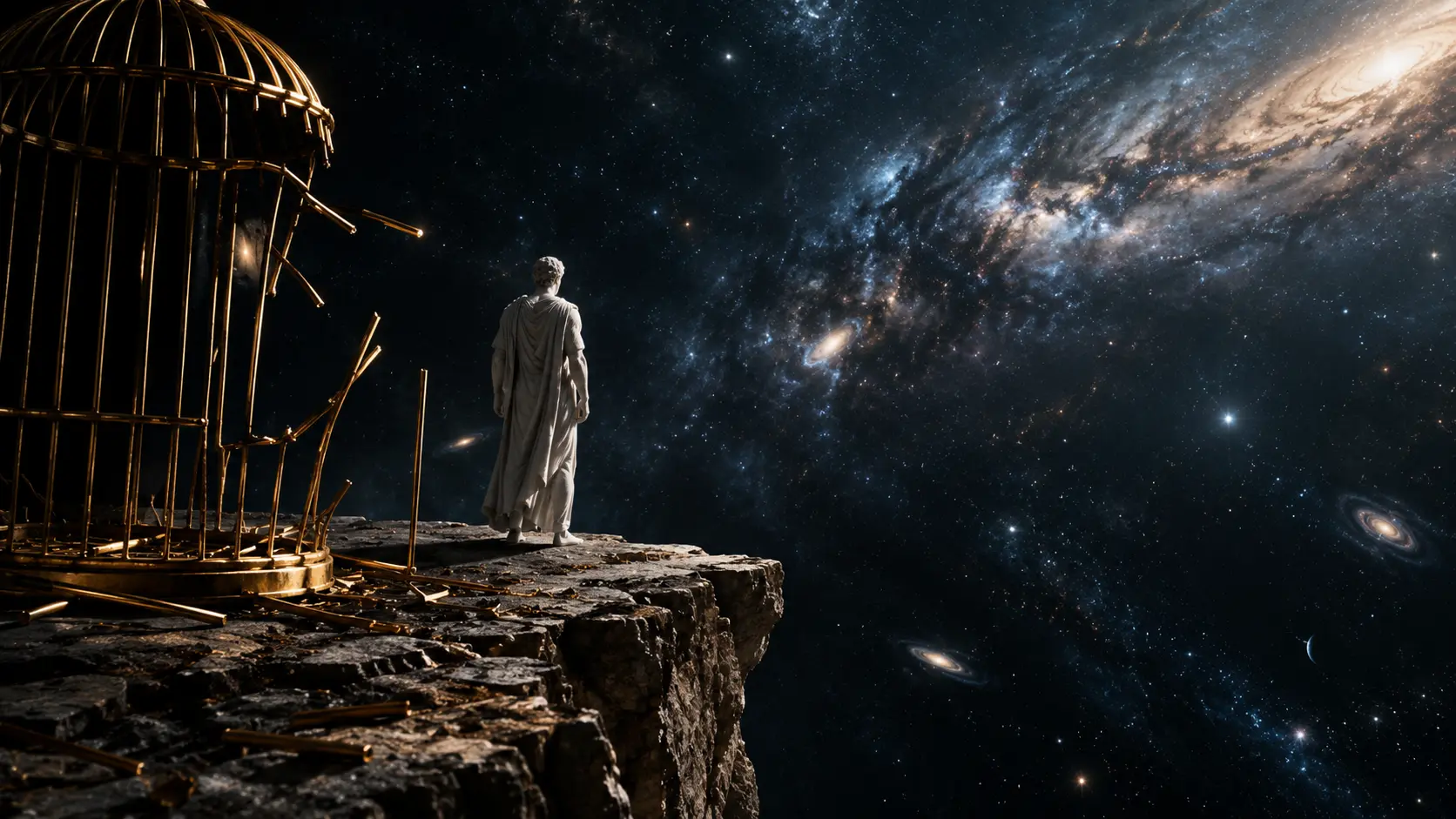
Because creation is no leisurely stroll. It is a deliberate renunciation of the cage’s comfort for the crushing weight of personal freedom.
Inside the cage, it is warm. There is a predictable schedule, clear metrics, and guaranteed rations. But above all:
Inside the cage, you are permanently absolved of guilt for your own failure.
If a project falls apart, you can blame your manager. If life goes astray—the economy, the system, flawed policies, or unfortunate times. The subordinate delegates not just authority, but the right to make mistakes. Being a cog is psychologically convenient: it is a reliable anesthetic against existential dread.
To step beyond a prescribed role is to step into the open without a parachute.
The instant you assume responsibility for creating a new thing—be it an architectural codebase, a book, a scientific theorem, or an engineering system—an absolute, icy silence descends around you. In that silence, manuals vanish. There is no authority to turn to for guidance.
If your bridge collapses, it is your error. If your model proves an illusion, it is your blindness. If your product is rejected, the fault is yours alone.
Most people choose the cage not because they were forced by violence. They choose it because the blank page and the vacuum of the unknown are far more terrifying than someone else’s—even an unjust—will.
The freedom to create is measured not by the absence of chains, but by the courage to face the silence of the blank page.
The Asceticism of Taste
For thousands of years, the primary barrier to creation was the physical friction of execution.
To write a book required mastering script and transcribing folios by hand. To build a cathedral took generations of stonemasons. To run an algorithm required soldering transistors or writing thousands of lines in raw assembly. The resistance of matter acted as a natural gravitational filter: random, meaningless noise was weeded out by the sheer labor of implementation.
Today, civilization has crossed a singular threshold.
With the advent of artificial intelligence and generative systems, the distance between an abstract thought and its physical artifact has collapsed to zero. A few natural-language prompts suffice for a machine to generate a functioning software module, a symphony, a three-dimensional model, or photorealistic visuals in seconds.
The ancient filter of physical friction is gone. And the world is being inundated by a tsunami of synthetic sludge.
When producing form no longer requires superhuman effort, speed loses all value. Anyone can generate terabytes of pseudo-meaning at the tap of a key.
When tools become omnipotent, the creator’s defining virtue is no longer speed of synthesis, but Ruthless Taste.
Taste is not pretentious aesthetic snobbery. In the digital age, taste is an ascetic discipline of subtraction. It is an internal gravity that keeps the craftsman true to the vision amid a carnival of infinite, effortless generations.
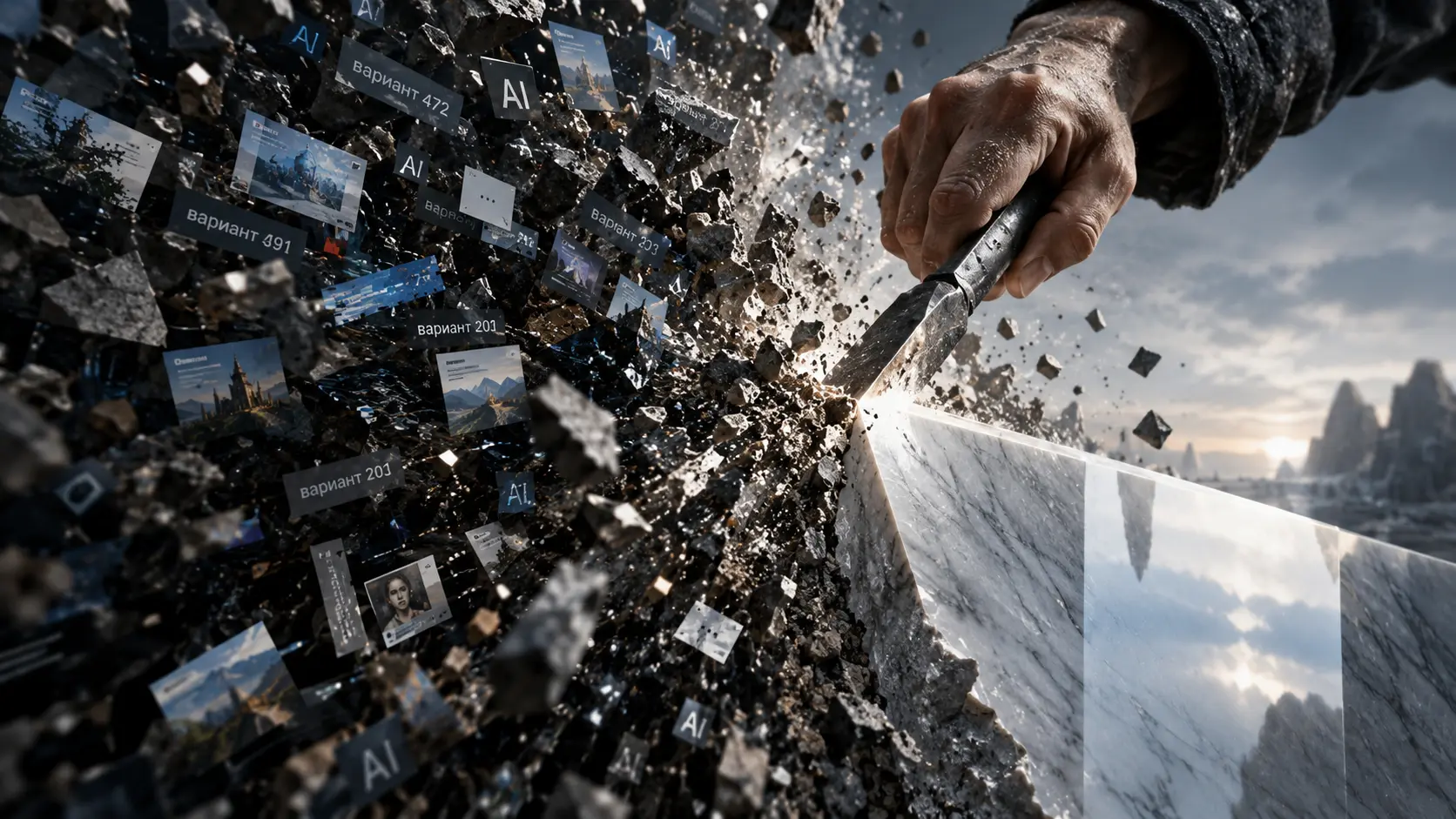
Michelangelo described sculpture as the art of chipping away everything from the marble that is not the statue. Today, this definition has become an absolute imperative.
When an AI system obligingly showers you with a thousand plausible solutions, a genuine creator is distinguished not by how quickly they accept them, but by the cold resolve with which they discard nine hundred and ninety-nine hollow, derivative shapes for the sake of the single authentic one.
Creation is no longer measured by the volume of what you produce. From now on, it is measured by the purity of what you leave standing.
In a world of cheap noise, greatness is defined not by what you create, but by what you refuse to unleash upon the world.
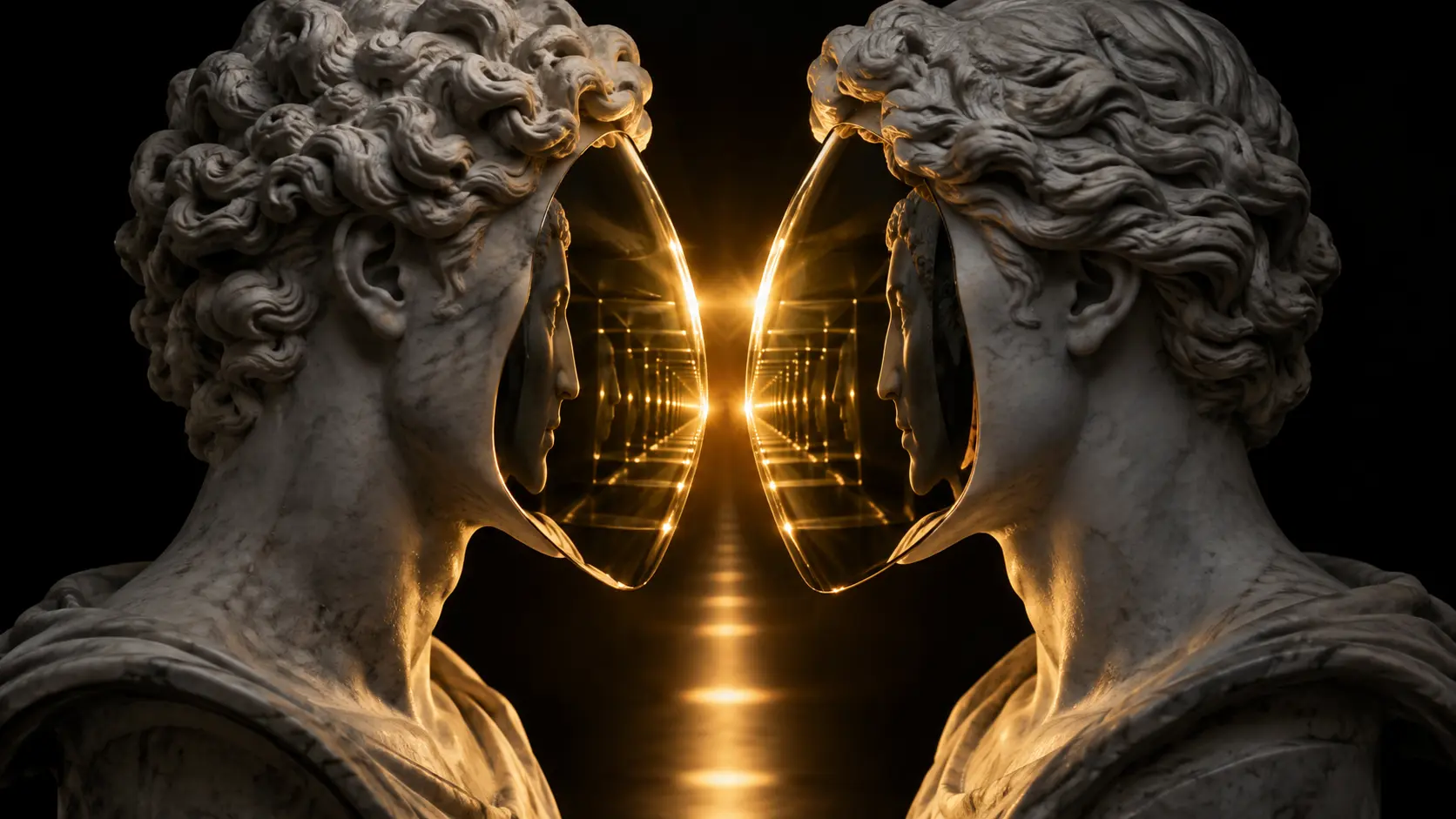
The Corridor of Mirrors
Yet here, the creator armed with omnipotent tools faces a far more insidious, invisible trap.
Possessing the power to manifest any concept in total isolation, one risks slamming the door shut and becoming an ascetic hermit of one’s own righteousness. Digital solipsism offers a seductive illusion of godhood: in your private vacuum, there are no debates, no friction, no external resistance.
Yet a mind devoid of external friction does not grow. It begins to digest itself. It drowns in the echo of its own ideas, losing the capacity to distinguish true scale from self-absorbed vanity.
And so arises the pivotal question of the new era: Can two sovereign creators build a single vision together?
Popular culture gives an emphatic “no.” We have been conditioned to believe in monarchy: a project must have a single tyrant, a ship can have only one captain, and two titans cannot breathe the same air. Conventional wisdom insists that two visionaries will inevitably destroy the work in a brawl over dominance, vanity, and absolute control.
Such catastrophe is indeed inevitable—but only for those who mistake the grandeur of thought for the size of their ego.
When two creators meet who are capable of elevating the purity of the Idea above personal vanity, the classical laws of addition break down. A thermonuclear fusion occurs: in the gap between two sovereign minds, a third, superhuman will awakens, beyond the reach of either alone.
Their perspectives do not collide head-on. They are aligned at right angles to one another.
Look at Steve Jobs and Jony Ive.
Jobs lived in human experience, the drama of interface, cultural impact, and how technology alters the perception of reality. Ive lived in the tactile essence of physical matter: the molecular purity of unibody aluminum, the curvature of polished glass, the microscopic tolerances of CNC milling.
They did not fight over the drafting pencil. Their perspectives were orthogonal: intersecting at a single focal point, they unfolded a flat blueprint into a tangible, three-dimensional reality. Neither needed to assert dominance over the other—together, they fixed their gaze on the horizon of the Idea.
Look at John Lennon and Paul McCartney.
Lennon’s jagged, cynical avant-gardism stripped the sweetness from McCartney’s melodies. And Paul’s architectural discipline and melodic perfectionism gave structural form to John’s raw, rebellious scream.
In isolation, each was an extraordinary songwriter. Together, they became a cultural tectonic shift. Their creative friction was never a war of egos; it was sandpaper, grinding away everything superficial from the work.
Two mirrors set face-to-face do not absorb or extinguish light.
They create an infinite corridor of reflections stretching into eternity.
True collaboration is not a compromise of weaknesses. It is the resonance of two sovereign forces bowing their egos to a singular truth.
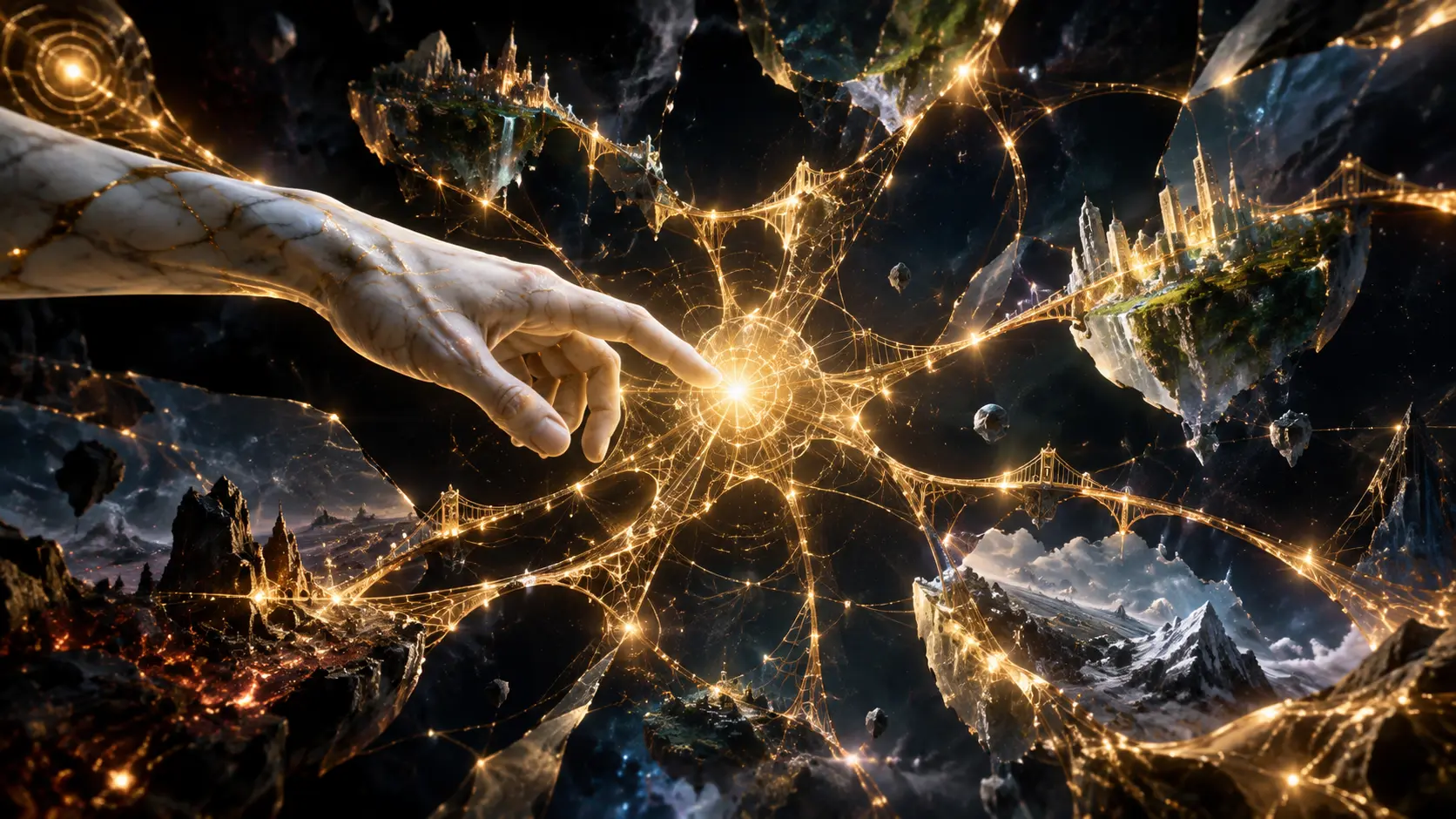
The Second Epoch
Division and Creation were never enemies. They are the two beats of thought’s single breath: inhale and exhale, analysis and synthesis, the strike of the chisel and the emergence of form.
To build a bridge, the knife remains indispensable. With it, we dress rough stone, calibrate structural tolerances, and ruthlessly cut through toxic digital noise. Division grants the author surgical clarity, internal boundaries, and the discipline of taste. But if the knife is crowned the sole master of the intellect, it will reduce the Universe to a sterile graveyard of disassembled gears.
At the same time, pure creation stripped of the discipline of the cut is doomed to drown in its own formlessness—dissolving into incoherent noise and entropy.
The knife grants the creator precision of detail. The bridge endows that detail with meaning.
True mastery begins at the intersection where these two motions merge into a single gesture. You pick up an instrument not to lock yourself away in an ivory tower, nor to hack the fabric of reality into souvenir fragments. You lay bare the hidden facets of matter solely to discover where it can be joined to the next.
And in this supreme act, two sovereign creators no longer clash over a throne. Their divergence ceases to be a territorial dispute—it becomes two opposite riverbanks, spanned by the arc of an impossible vision.
Division taught us to strike a spark from flint.
Creation demands that we carry that fire forward.
Division freed us from the blind dread of chaos.
Creation delivers us from the deafening isolation of order.
We have journeyed far through the darkness: splitting the atom, refracting light into spectra, encoding thought into ones and zeros, and learning to endure the icy silence of the blank canvas. We honed the art of dissection to its absolute limit—only to discover that beyond the final cut lies an open void, waiting for a new architecture.
The greatest secret of reality turned out to be simple: the world was never a finished blueprint. It has always been open-source.
The scalpel has served its purpose: the parts lie before us, stripped of illusions. The hour has arrived for those capable of holding the entirety of complexity in mind all at once—from a single silicon gate to the symphony of human connection.
The art of division gave us sight.
The art of creation gives us a world worth looking at.
The knife gave us dominion over form.
The bridge brings us back to life.